
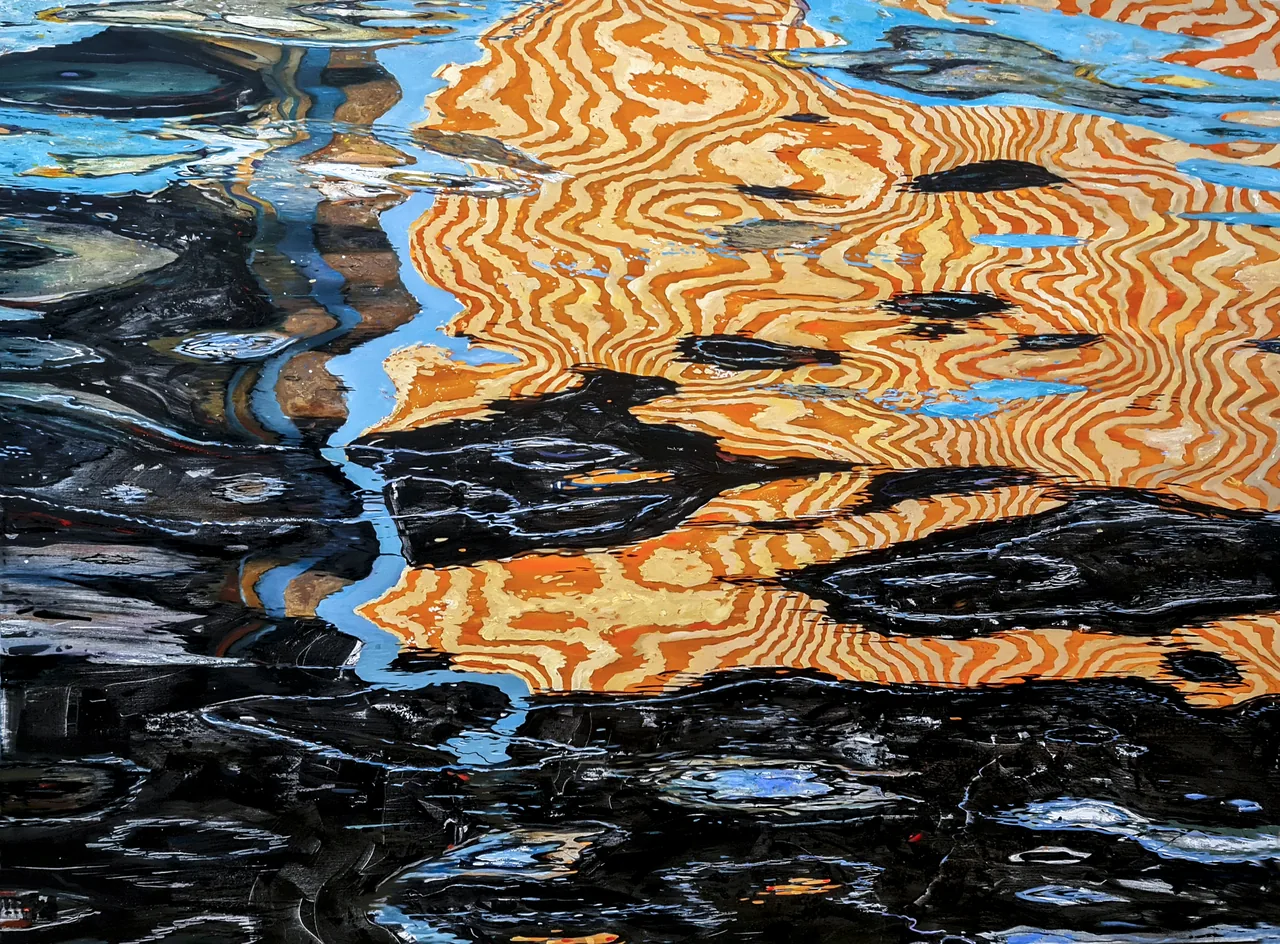
Specular Water
The surface of water as a mirror and a territory of perception. In this series, reflections, light, distortions, and liquid fragments alter our perception of reality, creating images that oscillate between the recognizable and the ambiguous.
Water ceases to be merely an element of the landscape and becomes an active surface, capable of transforming whatever it reflects. Each image captures a moment in constant flux, where reality is fragmented, distorted, and reconstructed through light and movement. Since 2026 some works add gold leaf to the oil.
The series gave its name to the exhibition Agua especular (Arte1010 Gallery, Mérida, 2024), curated by David Mateo, a title taken from Borges' poem “Los espejos”.
Critical text · David Mateo, 2024
Visions and routes in the painting of Luis Alberto Saldaña
Over these years devoted to researching and curating the landscape genre in Cuba, it has always struck me as strange, even unsettling, that rural approaches should prevail over marine ones, above all in the work of the young artists who have been joining the field of painting. I would venture to set out a few personal considerations in an attempt to infer some of the possible causes of this “imbalance” in a cultural setting such as ours, where the island condition—in any of its manifestations—ought to be a perceptual and symbolic leitmotif.
I am convinced, for example, that the choice between approaching one type of landscape or another has been mediated, on the one hand, by a subjective, allegorical circumstance, and on the other by a technical, procedural dilemma.
Despite being surrounded by seas and oceans—figurative dimensions ideally suited to evoking pilgrimage and escape—Cubans continue to direct their states of subjectivity towards the interior of the island, as territories of refuge and safe passage. The vastness of the water, its currents and its depths, paradoxically become intimations of unease and danger. Not for nothing that reiterated poetic reference, that recurring forced refrain in the art of the island, which alludes to Virgilio Piñera’s metaphors: water surrounding us “like a cancer”, or as a “damned circumstance”.
Cuba, moreover, is an eminently rural country, and a good number of the artists who have trained as landscape painters come from that context; their careers unfold almost entirely on the “presumption” of certain sensibilities for observation and imitation that stem essentially from that lineage. So strong has the persistence of this attitude been that the artistic representation of the countryside seems to have neglected certain devices of critical reconciliation, of rational tempering, which ought to prevail in any interpretive exercise mediated by feeling or inspiration, and it has gradually become permeated with sweetened, bucolic visions and with a number of structural formulas or bad habits.
I believe there is also a certain technical accommodation at work in this inclination towards rural or maritime landscape. The countryside, with the exuberance of its relief and its plant motifs, its gradations of colour, proves far more “forgiving” of the display of pictorial artifice and simulation. The sea, however, has a fragile, unstable, translucent make-up that is much harder to reproduce. Owing to the effects of weather, the shifting light and the sudden reflection of reality, that configuration is constantly changing, which makes it all the more complex to capture and “apprehend” certain parameters of its density.
I would go further still in comparing the two processes, and assert that rural landscape can find its guarantee of visual realisation in the artist’s perceptive acuity and command of technical artifice. To observe conscientiously and then represent the fickle appearances of the marine world, however, one must add something extra to the skill displayed in elementary painterly practice—an extra that rests on one’s personal capacity for association and compositional speculation.
Whenever I approach the field of marine painting in Cuba and the meagre output it reveals, I imagine the hesitation or reluctance of some painters before these complex questions or dilemmas: How can one remain expectant and at the same time objective, even-handed in the creative process, before what the sea reveals of its identity and what it merely suggests? How can one take on the diversity of optical illusions it constantly generates—hinting at other visions and substances—without losing the basic perception of water in motion? How can one presume to interpret the physical magnitude of a substance, of a state, solely from a distant, panoramic position, when the most curious, the most hallucinatory things happen in the dynamics of the foreground? How can one cling to a figurative perspective in taking up this kind of landscape, when it is a setting whose most salient features are constantly tempting the abstract dimension?
These questions have helped me not only to try to understand the dilemma of choice facing the Cuban marine painter, or to unravel the dichotomy of values arising within what has been produced so far, but also to devise my own scale of appraisal for the works and the few artists devoted to this kind of painting. I admit that the affirmative, instructive answers these questions have yielded have so far led me only to identify with the landscape work of two Cuban artists of different generations and styles, yet with what are, in my view, complementary representational stances and premises. I am referring to Luis Antonio Espinosa Fruto (1974, Manzanillo, Cuba) and Luis Alberto Saldaña Soto (Güines, Cuba, 1987). On Espinosa’s curatorial projects and work I have left testimony in several publications where I have worked as editor and art critic. On Luis Alberto Saldaña’s landscape practice, however, I am only now beginning my enquiries and offering some public reflections.
The first time I consciously approached the work of this young artist from Mayabeque was in 2015, during a visit to a group exhibition organised by Galería Galiano as part of the “Post it III” competition. That day I was able to see a diptych from the series “Estereotipos” and to have a pleasant conversation with the artist; later I had the opportunity to see other works from the same body of work.
My attention was drawn by the peculiar execution of those figurative paintings set in an atmosphere of utter darkness, in which an allegorical contrast was hinted at between the human figure and certain artefacts or symbolic objects, and a dramatic tension was suggested between the grave, circumspect appearance of a kind of surrealist male spectre and the interpretive pliancy of some of the images attached to it.
Everything at that moment suggested that Luis Saldaña’s painting was moving towards an eminently conceptual discourse, with social and philosophical concerns; I offered him a few suggestions and praised him for having chosen that path of symbolic representation. Yet barely two years later, in 2017, I witnessed an unexpected thematic shift. Two of his seascapes appeared in the group exhibition “Cartografía de un sendero”, presented at the Centro de Desarrollo de las Artes Visuales, which I visited as part of my usual rounds of the Havana circuit. The works in the “Estereotipos” series alluded to a kind of inquisitorial attitude associated with the city, with urban contexts; but I remember that, curiously, they also included some elements drawn from the marine habitat, such as fish, coastal rocks, conch shells…; at the time, though, I took them only as random conceptual devices, not as premonitory signs of a possible foray into this kind of landscape.
I can say, then, that those two pieces at the Centro de Desarrollo de las Artes Visuales (titled Proa and Window) were what led me, in a reserved, cautious way, towards the marine pictorial universe that Luis Saldaña had been developing in parallel and which I did not yet know. The moment that definitively sparked my interest and my wish to engage with his work, however, came only very recently, once I had settled in Mexico, when I began to review the medium- and large-format works that make up the series “Anatomía”, with which he has so kindly invited me to curate an exhibition for Galería “Arte1010” in Mérida, Yucatán. I have been able not only to examine everything Saldaña has produced within that series to date, but also to witness the convincing technical and methodological evolution he has undergone in a short period of time—which is why I believe the temporary withdrawal of the “Estereotipos” series has been well worth it.
Without a doubt it has been the artist’s curiosity, his eagerness to observe the processes of reflection across the expanse of the sea, that has spurred his gradual experience of drawing closer, of concentrating planes, of optical experiment. If one looks carefully at the inventory of works conceived within the series, one will notice that at first the priority was to imitate the forms showing through on the surface of the sea (a wooden boat, say, a harbour building, the rusticity of a pier…), revealing the elementary modifications of the drawing and of the tones that compose them. Reality appeared in those pieces as highly synthetic, deducible, and somewhat reluctant to lose the essential features of its condition. But then the author gradually concentrates on those subtle, rapid, fleeting “struggles” that occur in layers in the phenomenon of refraction of solid bodies across the expanse of the sea. At times Saldaña even seems to emphasise only the disputes, the tensions of luminosity and colour, with no structural suggestion beyond what emerges from those apparent frictions and contrasts. The artist himself has reaffirmed these pictorial perceptions in the digital dossier he conceived for the series “Anatomía”: Water seen in three moments: through its face, which is the surface, the one that reflects and distorts the reality above; that lets show through and veils what lies beneath; and the one that grows in voluminous masses of waves and foam.
Everything gradually blends or condenses, is absorbed into a single plane within the painting, and the water acquires a singular anatomical dimension. That contingency of recognition and resignification between the world of objects and the watery surface is no longer so decisive; what matters is the process of compositional fusion between the two. As this concept is understood and assimilated, the artist’s drawing and brushwork become increasingly rudimentary, gestural. The extremely figurative line that aspired to precision of form and detail disappears, and an almost abstract expressiveness takes shape, yearning for the sketch, for suggestion. The painter’s evocative and interpretive faculty becomes evident with very few technical means. The structure is sustained by the combined use of straight or undulating lines, fine or thick, and the deployment of geometric bands or furrows of colour. With these constructive devices alone, Saldaña manages to convey the perpetual movement of water, its changing design, the systematic events of visual absorption, and transparency. This last effect is one of the things in his painting that impresses me most, for one senses that Saldaña has achieved it without constantly resorting to dilution and neutralisation, but rather by arranging the different ranges of colour, ordering them within the whole, and manipulating their gradations according to a given thickness or consistency.
A shrewd tension between the sensual and the rustic, the restrained and the gestural, is irremediably taking hold of Saldaña’s paintings, and threatens to become more dominant by the day, laying the groundwork for speculation about the artist’s turn towards abstraction—a dilemma that only time will resolve. Incidentally, I confess that at times I see the inductive, watchful spirit of a Martínez Pedro appear in his landscape work, some points of dialogue with his famous series “Aguas territoriales”. What matters, in my view, is that this gradual arrival at such a level of conception and method in marine landscape is what is strengthening the effectiveness of his work—ready, naturally, to confront and answer those crucial questions I listed earlier in this text—and above all what is earning him attention and recognition in the art worlds of Cuba and Mexico, and soon, I hope, of Latin America and the Caribbean.
If, after an enriching debate, the artist and I decided to title this exhibition at Galería “Arte1010” with the phrase “Agua especular”, taken from the poem “Los espejos” by the Argentine writer Jorge Luis Borges, it is because we believe there is no more fitting phrase to describe that enigmatic “musing” of reality and its surroundings revealed in the phenomena of refraction on the surface of the sea; and to denote, at the same time, the speculative capacity with which Saldaña immerses himself in that everyday, almost familiar habitat, while dialectically facing the transition of languages and representational processes in his painting.
David Mateo · Mexico, 14 April 2024 · Curatorial text for the exhibition Agua especular, Galería Arte1010, Mérida · Translated from the Spanish · source
Critical text · Tomás Sánchez, 2026
On the Work of Luis Alberto Saldaña
Since my first encounter with the work of Luis Alberto Saldaña, I have been interested in how his proposal is born from a primary gesture of observation and contemplation of water as a living, unstable surface, always in transit. In his case it is not a matter of representing the landscape of water, but of remaining in it long enough for its form to dissolve. In that process the motif is freed from its descriptive condition and becomes structure, rhythm, visual pulse.
Water, in his work, ceases to be a referent and becomes a field of forces. Lines, breaks and reflections are organised into an abstract cartography in which the gaze no longer distinguishes horizon or depth, but layers of time and movement. Each painting works as a fragment arrested from a continuous flow, a kind of liquid memory remade at every instant. A true devotion to that real and symbolic matter that is water.
From this drift, Saldaña places his work in a liminal zone of contemporary art: where contemplation is not escape but method; where abstraction does not deny the real but condenses and synthesises it. His watery surfaces do not represent the world: they absorb it, transform it and give it back as a sensory experience, silent and radically present.
Tomás Sánchez · January 2026 · Tomás Sánchez, Cuban painter. Text provided by the artist (2026); English translation by the artist, revised. · Translated from the Spanish
Oil on canvas · 150 × 200 cm (59 × 79 in)
Oil on canvas · 130 × 150 cm (51 × 59 in)
Oil on canvas · 150 × 170 cm (59 × 67 in)
Available
Oil on canvas · 150 × 200 cm (59 × 79 in)
Available
Oil on canvas · 76 × 64 cm (30 × 25.2 in)
Available
Oil on canvas · 130 × 170 cm (51 × 67 in)
Oil on canvas · 130 × 150 cm (51 × 59 in)
Available
Oil on canvas · 130 × 150 cm (51 × 59 in)
Available
Oil on canvas · 60 × 80 cm (23.6 × 31.5 in)
Available
Oil on canvas · 130 × 150 cm (51 × 59 in)
Oil on canvas · 130 × 150 cm (51 × 59 in)
Available
Oil on canvas, diptych · 130 × 100 cm each (51 × 40 in each)
Oil on canvas · 130 × 150 cm (51 × 59 in)
Available
Oil on canvas · 60 × 80 cm (23.6 × 31.5 in)
Oil on canvas · 100 × 80 cm (40 × 31.5 in)
Available
Oil on canvas · 100 × 80 cm (40 × 31.5 in)
Oil on canvas · 80 × 145 cm (31.5 × 57 in)
Oil on canvas · 130 × 150 cm (51 × 59 in)
Available
Oil on canvas · 60 × 80 cm (23.6 × 31.5 in)
Oil on canvas · 169 × 129 cm (66.5 × 51 in)
Available
Oil on canvas · 130 × 150 cm (51 × 59 in)
Oil on canvas · 150 × 200 cm (59 × 79 in)
Available
Oil on canvas · 150 × 200 cm (59 × 79 in)
Available
Oil on canvas · 150 × 200 cm (59 × 79 in)
Available
Oil on canvas · 100 × 130 cm (40 × 51 in)
Available · diptych
Oil on canvas · 120 × 91 cm (47 × 36 in)
Oil on canvas · 32 × 38 cm each (12.5 × 15 in each)
Oil on canvas · 140 × 96 cm (55 × 38 in)
Oil on canvas · 76 × 64 cm (30 × 25 in)
Available
Oil on canvas · 32 × 38 cm each (12.6 × 15 in each)
Oil on canvas · 60 × 80 cm (23.6 × 31.5 in)